
Marketing analytics for DeFi growth teams should separate campaign outcomes from protocol health. The DeFi metrics I report as campaign outcomes are attributed activated wallets, cohort retention, and acquisition cost. TVL and protocol-wide activity belong in context unless the team can show a credible causal link.
Growth teams often inherit dashboards full of large numbers. The hard part is not finding another KPI. It is defining ownership, unit, time window, and attribution before a number reaches leadership.
Marketing analytics for DeFi growth teams starts with ownership
Marketing can influence protocol growth without controlling every result. A campaign may bring users who later add liquidity, but price changes, incentives, product changes, and large deposits can also move total value locked. A weekly report should show the measured campaign result and name the other forces that could explain a protocol-wide change.
Google Analytics documentation describes events as interactions collected for measurement. That makes event design a useful starting point for an off-chain funnel. For on-chain behavior, the team must define which wallet action counts as activation and how a campaign source is connected to that wallet. A click or wallet connection alone does not prove useful product activity.
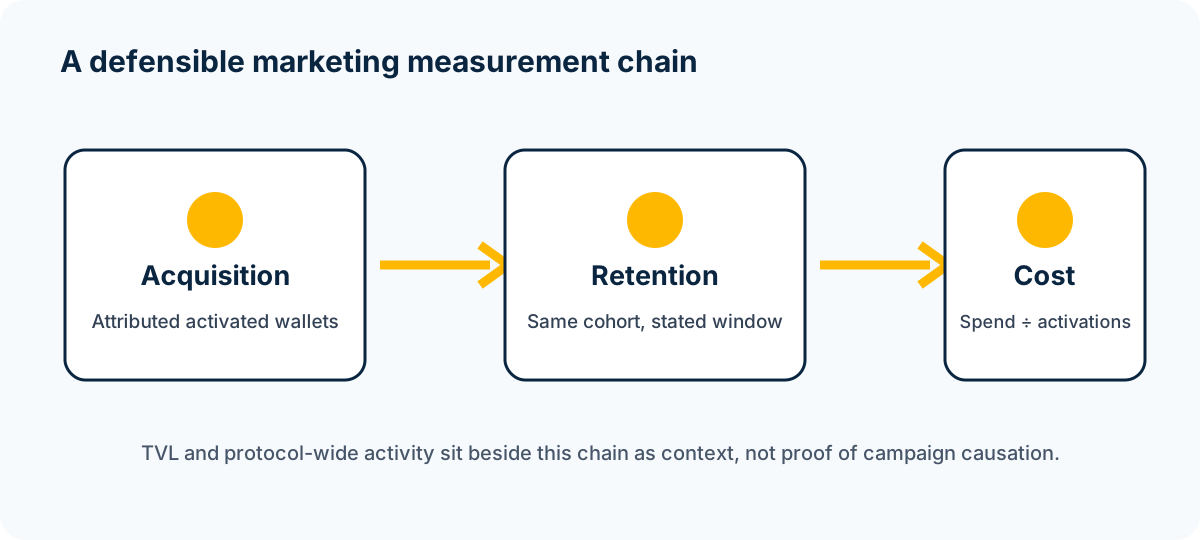
Three DeFi metrics a growth team can defend
Campaign-sourced activated wallets
Count wallets that complete a stated activation action and can be tied to a campaign under a disclosed attribution rule. The activation event depends on the product. It could be a first swap, a deposit above a stated threshold, or another meaningful action. Do not switch the event definition between reporting periods without marking the change.
Report the count by channel and campaign, with the observation window and the attribution method. Remove known Sybil or duplicate activity only when the filter is documented. If a campaign source cannot be connected to a wallet, label the result unattributed instead of assigning it by timing alone.
Post-campaign cohort retention
Retention asks what share of an acquired cohort returns to complete a defined action within a stated window. Keep the cohort rule, action, and window visible. A seven-day returning-wallet rate and a thirty-day returning-wallet rate answer different questions. Neither is meaningful without the denominator and a clear account of wallets that were eligible to return.
Compare like with like. A campaign that attracts users with a different product use case should not be ranked against a general acquisition cohort without explaining the difference. Incentive claims can also bring one-time activity. Separate participation during the reward period from later use.
On-chain customer acquisition cost by channel
Divide the campaign cost assigned to a channel by the number of activated wallets attributed to it. State which costs are included. Cash media, agency fees, quest rewards, referral payments, and token incentives may all matter, but the accounting rule should be consistent and documented.
This is a cost per attributed activation, not proof of lifetime value. Pair it with retention and downstream value only when those outcomes use a consistent cohort and measurement period. The attribution setup matters; see my DeFi campaign attribution framework.
Build an attribution rule before comparing channels
A useful campaign report begins before launch. Write down the campaign identifier, the source fields that can travel from a click or referral into product analytics, and the wallet action that qualifies as activation. If a campaign uses more than one entry path, map each path to the same naming convention. A tracking plan helps the team see where attribution stops working before a result is presented as complete.
Next, choose a reporting window that fits the decision. A short window can capture immediate activity but miss a slower product journey. A longer window can include more repeat behavior while making it harder to isolate the campaign from other exposure. The window is a method choice, not an industry benchmark. Keep it stable for comparisons, and mark any change in the dashboard and the narrative. For marketing analytics for DeFi growth teams, this small discipline protects channel comparisons from drifting definitions.
Document exclusions as carefully as inclusions. State how duplicate wallets, known bots, internal test accounts, and wallets without a reliable campaign source are handled. Do not silently discard records after seeing a result. If a filter changes, show the old and new definitions side by side for the affected reporting period, then establish a new baseline under the revised method.
Where a user sees several campaigns before activating, last-click attribution may assign all credit to the final touch. A first-touch rule tells a different story. Neither rule proves that the campaign caused the action. For a small or noisy cohort, describe the association and its limitations. A controlled experiment or a documented holdout can strengthen causal claims, but only if the assignment and exposure are actually measured.
These choices matter more in DeFi because one wallet can interact through several protocols, chains, or interfaces. A wallet address is a useful identifier for some on-chain actions, but it does not always represent one person. A user may split activity across addresses, and a shared or custodial wallet can combine multiple users. Explain what the unit represents before using a wallet count as a user count.
For leadership, put the decision and the evidence together. For example, say which campaign brought attributable activations, whether that cohort returned under the chosen rule, and what cost categories were included. Then describe what remains unknown, such as unattributed wallet activity or a product change during the measurement period. This keeps the report useful without overstating certainty.
DeFi metrics that belong in the context column
DeFi metrics such as TVL, daily active wallets, monthly active wallets, fees, token price, and protocol revenue can help explain the operating environment. They do not automatically show that marketing caused a change. A report can state that a campaign coincided with a TVL increase, then list other plausible causes and avoid claiming attribution the evidence cannot support.
Metric labels also vary across dashboards. Before using a ratio such as daily active wallets divided by monthly active wallets, verify how each source defines an active wallet, the chain coverage, and the date window. Treat thresholds as protocol-specific unless a comparable source and method support a broader benchmark. Without comparable evidence, report the observed value and method instead of presenting a universal target.

A measurement table for a weekly DeFi growth report
Use one row for each metric that informs a decision. The table below makes the required definition visible before a team compares results.
| Metric | Definition to record | Unit and window | Limit |
|---|---|---|---|
| Activated wallets by campaign | Named activation event plus attribution rule | Wallets per campaign and reporting period | Unattributed wallets stay separate |
| Cohort retention | Eligible cohort that repeats the defined action | Returning wallets ÷ eligible wallets, by stated window | Does not prove why users returned |
| Acquisition cost | Included campaign costs divided by attributed activations | Currency per activated wallet, by channel | Not lifetime value or profitability |
| TVL and protocol activity | Source-specific protocol metric and coverage | Source unit, chain, and observation period | Context unless causal evidence exists |
For each row, record the source, query or event definition, date range, exclusions, and any tracking change. Google Search Central also notes that title links and snippets can be generated from several page signals. Search performance can help prioritize content, but impressions and positions are not business outcomes and should not be mixed into campaign performance claims.

How DeFi marketing strategies shape metric choices
DeFi marketing strategies should start with the decision. If the question is which channel brought activated users, inspect campaign attribution and activation. If the question is whether those users returned, inspect a defined cohort. If the question is where to allocate next, compare cost with retention and the quality of downstream behavior. If leadership asks about protocol health, present TVL and activity as separate context with their source and period.
Then check the measurement chain for gaps. A missing source tag weakens attribution. An unclear activation event makes acquisition counts hard to compare. A changing cohort rule breaks retention comparisons. A cost calculation that omits incentives can make a campaign look cheaper than it is. Name these limits in the report. This is how DeFi marketing strategies connect campaign execution to a measurement rule the team can defend.
FAQ
Which metrics should a DeFi marketing team report?
Report campaign-sourced activated wallets, retention for a defined campaign cohort, and cost per attributed activation. Include protocol-wide figures as context and state the source, unit, and period.
How do you measure campaign-sourced wallet acquisition?
Define the campaign attribution rule and the on-chain action that qualifies as activation. Count wallets that meet both rules in the stated window, and keep unmatched activity separate.
How should DeFi teams calculate retention?
Choose a cohort, define a returning action, and state the observation window. Divide wallets that complete the action by eligible cohort wallets, and disclose exclusions or tracking gaps.
What is on-chain customer acquisition cost?
It is the included channel spend divided by activated wallets attributed to that channel. State whether incentives and other campaign costs are included. Pair the result with cohort outcomes before making efficiency claims.
Should marketing teams report TVL?
They can report TVL as protocol context with its source and time period. They should not claim it as a marketing outcome unless they can support the causal link and account for other drivers.
References
- Google Analytics: Events in Google Analytics, accessed 2026-10-20.
- Dune documentation: API overview, accessed 2026-10-20.
- Google Search Central: title links, accessed 2026-10-20.
- Google Search Central: snippets, accessed 2026-10-20.
What I will check next
I would review the tracking definition before comparing another campaign cohort. That is where a reporting decision becomes testable: the activation event, source rule, eligible population, and included cost are all visible. I use that discipline to distinguish growth activity from evidence of growth.
Need a clearer growth measurement system?
I review the metrics, attribution rules, and reporting structure a Web3 growth team can defend.
Explore the Web3 Growth Audit